
 English
 Español
How to Choose a Bath Bomb and Body Care OEM Manufacturer: A Buyer's Checklist
Source:www.besthopebath.com
|
Author:Besthope Bath
|
Published time: 2026-09-21
|
17 Views
|
🔊 Click to read aloud
❚❚
▶
|
Share:
A qualified bath bomb OEM manufacturer proves three things before you sign: verified compliance (ISO 22716 GMP, BSCI audit, FDA registration), an in-house lab with real test reports, and stable, inspectable quality. Verify certificates, samples, QC and compliance, then confirm with a trial order.
How to Choose a Bath Bomb and Body Care OEM Manufacturer: A Buyer’s Checklist
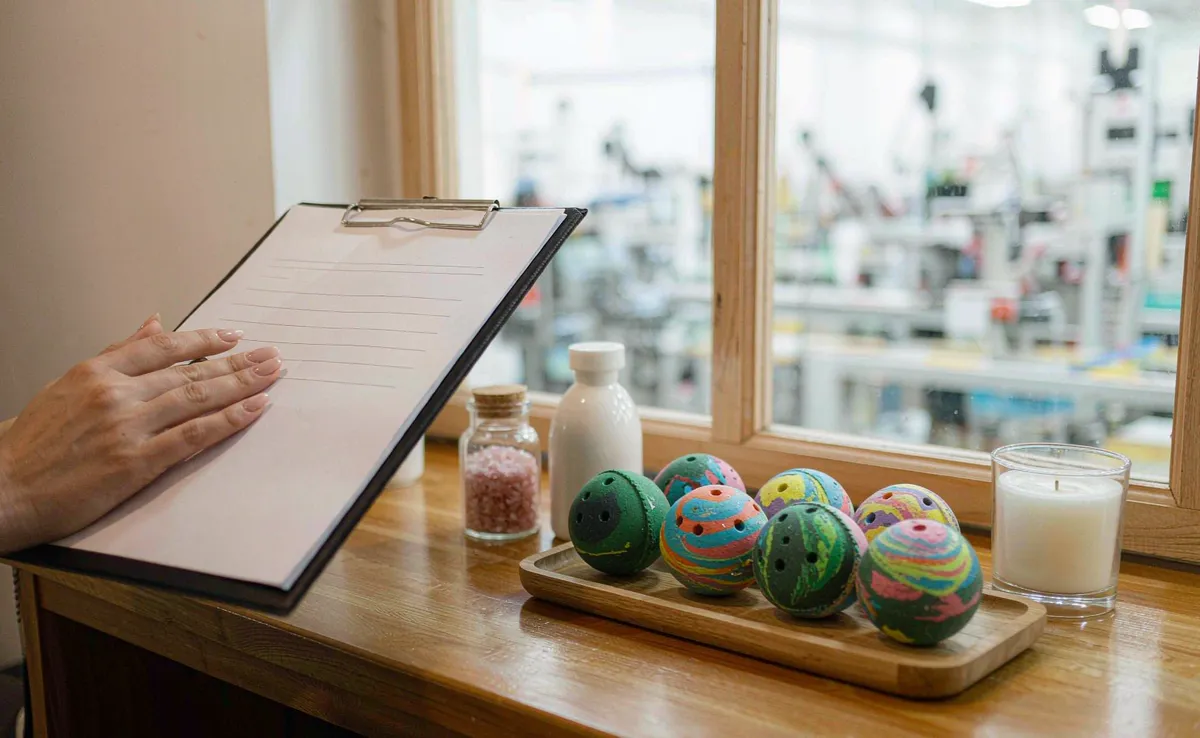
A qualified bath bomb OEM manufacturer proves three things before you sign anything: verified compliance (GMP such as ISO 22716, a social audit like BSCI, and FDA facility registration for the US market), in-house R&D backed by real test reports, and stable production quality you can inspect at every stage. Work through the seven-point checklist below, then confirm everything with a small trial order before you scale.
Quanzhou Besthope Household Products Co., Ltd. (Besthope Bath) is an OEM/ODM manufacturer of bath bombs, shower gels, body lotions, bath salts, gift sets, and scented candles, operating under GMP aligned with ISO 22716 cosmetics GMP, with amfori BSCI social-compliance audits, Walmart factory-audit experience, FDA-compliant documentation for US buyers, and an in-house laboratory for formulation and stability testing. This checklist is built from the questions wholesale buyers and brand owners actually ask us before their first purchase order.
Why the Choice Matters More Than the Price Sheet
Your manufacturer is the quality ceiling of your entire supply chain. A unit price that is 5% lower means nothing if a shipment arrives crumbled, mislabeled, or held at customs — recalls, marketplace takedowns, and re-shipping costs wipe out months of margin. The stakes are rising with the category: Grand View Research values the global private label cosmetics market at USD 10.6 billion in 2024, expected to reach USD 14.4 billion by 2030 (about 5.2% CAGR), which is pulling thousands of new brands — and new factories of very uneven quality — into the private label cosmetics market.
Bath bombs are also unforgiving products. Fizz reaction, hardness, color bleeding, fragrance load, and packaging integrity all depend on factory-level controls: raw material grades, humidity during pressing and curing, curing time, and carton drop testing. A trading company cannot control those variables; a real manufacturer can show you how.
The 7-Point Due-Diligence Checklist
- 1. Certifications you can verify. Ask for certificate numbers, not photos: GMP aligned with ISO 22716, an amfori BSCI social audit report, FDA facility registration for US-bound goods, and per-batch COA/MSDS. Check certificate validity and scope with the issuing body; a genuine factory sends documents the same day.
- 2. An in-house laboratory. The lab should run stability testing, adjust fizz, hardness, and color, and control fragrance compliance (IFRA certificates for every scent). A factory without its own lab outsources problem-solving — usually to you.
- 3. Samples that match the specification. Evaluate hardness, fizz time, color bleed on wet skin, scent throw in the box, and packaging fit. Benchmark against a competitor product you admire. One golden sample, signed and sealed, becomes the mass-production reference.
- 4. Production capacity and QC process. Look for dedicated pressing and curing areas with humidity control, AQL-based inspection, and the right to book a third-party pre-shipment inspection (SGS, Intertek, QIMA). A factory confident in its QC welcomes inspectors; a weak one delays them.
- 5. Regulatory support for your market. For the EU, the factory must feed data into your Responsible Person file: safety assessment (CPSR), product information file, and CPNP notification under Regulation (EC) No 1223/2009. For the US, ask how they support MoCRA facility registration and product listing. A serious OEM already has templates for both.
- 6. Communication and project management. Expect replies within one business day, one accountable contact per project, documentation in English (and Spanish for LatAm and Spain programs), and a written milestone path: quotation → samples → golden sample sign-off → mass production → inspection → shipment.
- 7. Export and logistics experience. Bath bombs ship badly if packed casually. Ask about export carton drop tests, sea-freight moisture protection, trade terms (FOB/CIF), and experience shipping to your ports. Factories that export daily will already know where bath bombs break.
Red Flags That Should End the Negotiation
- Certificates without numbers, or audit reports older than 24 months that cannot be re-verified.
- Refusal of third-party inspection or pre-shipment AQL sampling.
- Quotes far below market with no explanation of raw material grades (citric acid grade, SLSA type, fragrance load percentage).
- No written NDA or formula-ownership clause for OEM projects — your formulation belongs to whoever holds the paperwork.
- Inability to name fragrance suppliers or provide IFRA conformity certificates.
- “Golden sample? The mass production is the same.” Any factory without a sign-off process will ship you a surprise.
Confirm Everything With a Trial Order
Checklists reduce risk; a trial order eliminates it. Run a small pilot batch against the signed golden sample, book a pre-shipment inspection, and compare delivered goods photo-by-photo with the approved reference. If the pilot holds — weight, fizz, color, scent, packing — you have found a partner, not just a supplier, and you can scale with predictable quality.
Frequently Asked Questions
What certifications should a bath bomb manufacturer have?
At minimum: GMP aligned with ISO 22716 for cosmetics, a social-compliance audit (BSCI or SMETA), FDA facility registration for US-bound products, and per-batch COA/MSDS documentation. Request certificate numbers so you can verify them with the issuing bodies.
How long does sampling take?
With existing molds and stock fragrances, 5–15 working days is typical; custom shapes, colors, or new fragrance blends need roughly 2–4 weeks including iteration. Always finish with a signed golden sample before mass production starts.
Do I need a third-party inspection for bath bombs?
For a first order, yes. An AQL-based inspection checks weight, appearance, moisture, and carton integrity before goods leave the factory. Reputable manufacturers book the inspection window for you and pay for re-work if the goods fail.
Who handles EU and US compliance?
In the EU you appoint a Responsible Person who holds the product information file, safety assessment, and CPNP notification; the OEM factory supplies the technical data. In the US, MoCRA requires facility registration and product listing; your manufacturer should provide registration support and ingredient documentation.
Shortlisting OEM partners for a bath bomb or body care program? Send your target market, MOQ, and product brief through the Besthope Bath contact page — our team will return a quotation, samples plan, and the compliance documents listed in this checklist.
Quanzhou Besthope Household Products Co.,Ltd
Add:Chengnan Central Industrial Zone, Hui'an County, Quanzhou, Fujian, China
Tel:+86-595-87325398 Fax:+86-595-87325757
Email: luosonghuang@besthopebath.com Web: www.besthopebath.com
For more information, please leave us a message!
Copyright © 2022 Quanzhou Besthope Household Products Co.,Ltd. All Rights Reserved.
Images are sourced from the internet. If there is any infringement, please contact us for removal.